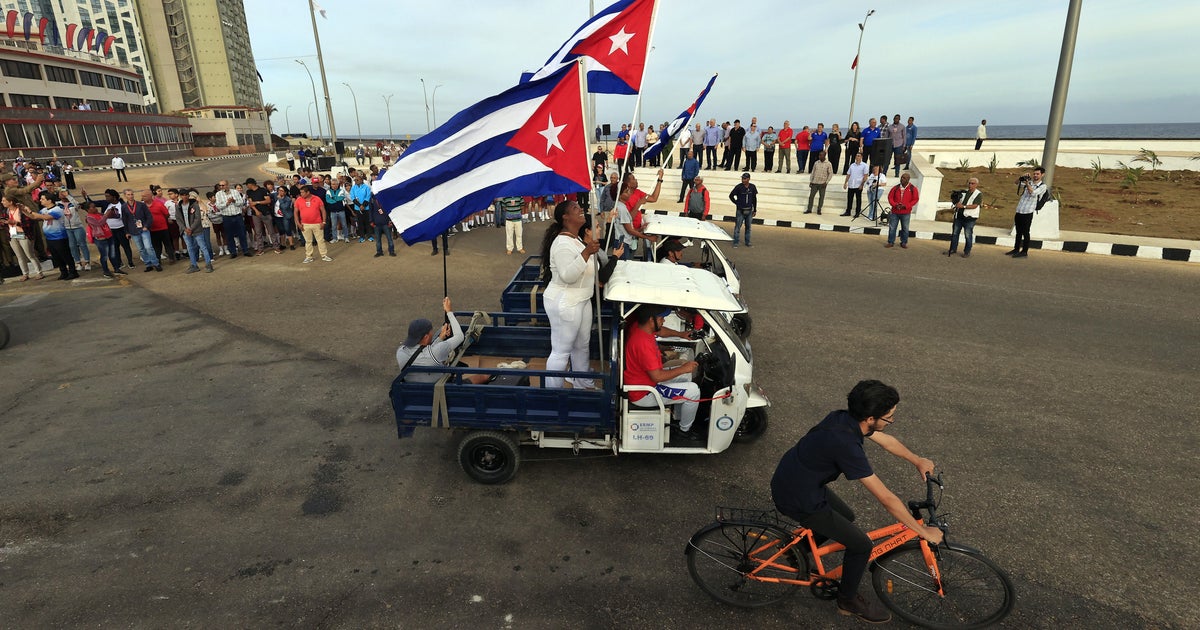
In recent weeks, President Donald Trump has intensified his rhetoric regarding Cuba, suggesting a potential military response as part of a broader strategy influenced by the administration’s actions in Venezuela. During a press conference, Trump hinted at the possibility of deploying an aircraft carrier off the coast of Cuba, framing the scenario as a means for the regime to capitulate. This aggressive stance follows the U.S. military’s successful operation that resulted in the capture of Venezuelan President Nicolás Maduro in January, which Trump has touted as a significant achievement.
Trump’s remarks have raised eyebrows among experts, who caution that military intervention in Cuba would be significantly more complex than in Venezuela. Secretary of State Marco Rubio has echoed Trump’s sentiments, stating that the Cuban regime should be on alert and expressing a desire for regime change in Cuba. He has characterized the current government as ineffective in addressing the island’s economic woes, indicating that new leadership is necessary for meaningful reform.
Despite the tough talk, analysts suggest that the threats of military action may be more bluster than reality. The political landscape in Cuba, characterized by a long-standing regime adept at suppressing dissent, complicates the notion of a quick regime change. Paul Hare, a former British ambassador to Cuba, noted that while some factions within the Trump administration may prefer a complete overhaul of the Cuban government, others might be open to negotiating with existing leaders for economic concessions.
The Trump administration has been actively attempting to cripple Cuba’s economy through stringent sanctions, including an oil blockade that has led to severe fuel shortages on the island. The economic situation in Cuba is reportedly the most dire it has been since the Soviet Union’s collapse, with the government struggling to provide basic services and resources to its citizens. In mid-May, Cuban officials acknowledged that the country had run out of fuel, attributing the crisis largely to U.S. sanctions.
In a rare diplomatic gesture, CIA Director John Ratcliffe traveled to Havana in mid-May to meet with Cuban officials. This visit was framed as an opportunity to communicate the U.S. willingness to engage economically and security-wise, contingent upon Cuba making significant changes. However, Cuban Deputy Foreign Minister Carlos Fernández de Cossío dismissed the likelihood of military action, asserting that Cuba’s military is prepared to respond to any threats.
The prospect of regime change in Cuba raises questions about what such a transition would entail. Experts agree that the entrenched political structure poses significant challenges, with the current leadership having maintained power for nearly 70 years. Christopher Hernandez-Roy from the Center for Strategic and International Studies indicated that while there might be internal pressures for change, achieving a successful transition would be markedly more difficult than in Venezuela. He emphasized that a purely diplomatic solution without coercion is unlikely to succeed.
The political dynamics in Cuba have shifted since Raúl Castro stepped down in 2018, passing the presidency to Miguel Díaz-Canel. While Díaz-Canel is viewed as a figurehead, the Castro family continues to exert considerable influence. Any transition in leadership would likely need to navigate this complex power structure, further complicating U.S. efforts for regime change.
Some analysts propose that the U.S. might support a leader who aligns with its interests, as a way to initiate gradual economic reforms. Lawrence Gumbiner, a former U.S. diplomat in Havana, suggested that the U.S. could leverage economic openings to pressure Cuban leadership into compliance, although he noted that the threat of military action remains minimal. He highlighted the Trump administration’s focus on Cuba as a potential market for U.S. businesses, viewing it as an opportunity for economic expansion rather than a straightforward political objective.
As the situation evolves, the Trump administration faces the challenge of balancing military posturing with practical diplomatic engagement. With various factions within the government advocating for differing approaches, the path forward regarding Cuba remains uncertain. The complexities of the Cuban political landscape and the potential for backlash against U.S. intervention highlight the challenges of enacting meaningful change on the island.
Source: CBS News


Leave a Reply