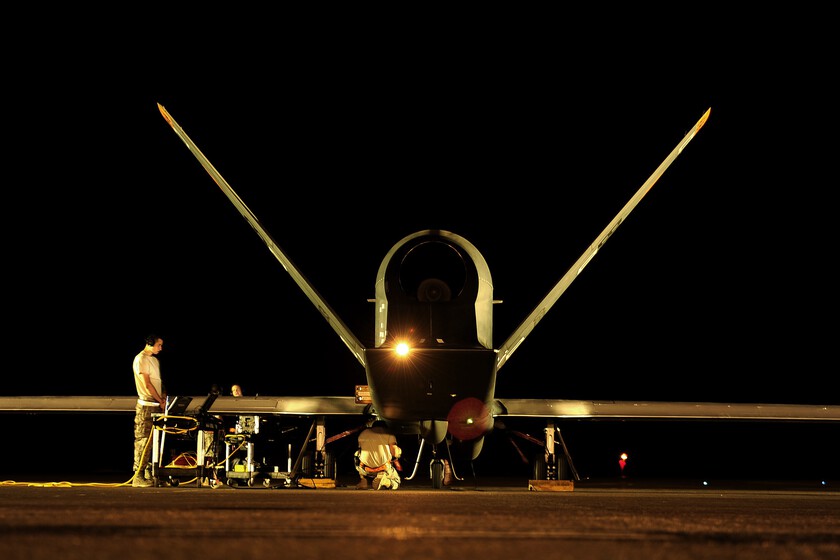
Project Maven and the Rise of AI
One of the most notable examples of this transformation is Project Maven, initially developed by Google and now managed by Palantir. Launched in 2017, Project Maven aimed to improve the Department of Defense’s ability to interpret vast quantities of video data from drones. This project harnesses AI to analyze data such as satellite imagery and intercepted communications to generate target lists and coordinate attack strategies. The speed at which these systems operate has compressed traditional decision-making timelines, with military officials describing the process as simple as ‘cclick left, click right.’ This marks a dramatic shift from conventional military engagements where human judgment played a central role.
Financially, Palantir has positioned itself as a leader in this realm, reporting revenues of $1.5 billion in 2022, with a significant portion of its business stemming from government contracts. The company has seen its stock rise steadily, reflecting investor confidence in its role in military and intelligence applications.
The Global Arms Race in AI
The competition among the world’s superpowers’particularly the United States, China, and Russia’has intensified as each country seeks to gain a technological edge in autonomous warfare. In China, the development of coordinated drone swarms and AI platforms capable of operating alongside manned aircraft reflects a commitment to scaling up automation in military operations. The Chinese government has invested heavily in military modernization, with a defense budget of approximately $230 billion in 2022, focusing significantly on AI and autonomous systems.
Meanwhile, Russia is advancing its capabilities with autonomous drone systems like the Lancet, which are designed to select targets independently. In 2022, the Russian military reportedly deployed these drones in combat, highlighting their commitment to integrating AI in warfare. In the U.S., the focus is on closing technological gaps by accelerating the production of autonomous drones through companies like Anduril, which secured a $1 billion contract in 2021 to deliver autonomous systems to the military. The pursuit of speed in development is becoming as crucial as the technology itself, creating a high-stakes environment where the first to innovate may dominate future conflicts.
Ukraine as a Testing Ground
The ongoing conflict in Ukraine has served as a significant testing ground for these emerging technologies. The war has demonstrated that relatively simple systems can quickly evolve into semi-autonomous capabilities that alter the balance of power on the battlefield. Adapted commercial drones, unmanned vessels, and sophisticated data analytics systems have enabled Ukrainian forces to resist a larger adversary. Reports indicate that as of late 2022, Ukraine had received over 600 Switchblade drones from the U.S., which have been utilized effectively against Russian armored units.
In response, Russia has begun integrating progressive automation into its military systems. The conflict has illustrated that military effectiveness can be achieved with systems that are not overly complex, with both sides utilizing drones, artillery, and intelligence-gathering technologies to gain a competitive edge. Analyst Michael Horowitz points out that Ukraine has acted as a laboratory for military innovation, accelerating a transition away from experimental technologies toward operational use. This conflict has highlighted the practical applications of AI and automation in real-time combat scenarios.
Silicon Valley’s Role in Military Innovation
Unlike previous arms races, the current landscape involves not only nation-states but also technology firms and startups that are redefining military development. Companies like Google initially engaged with projects such as Project Maven but later withdrew due to internal pressures, leaving space for firms like Palantir and Anduril that align more closely with defense objectives. In 2021, Anduril reported revenues of over $200 million, reflecting a growing demand for its autonomous drone technology and battlefield analytics.
In China, the civil-military fusion model integrates private enterprises directly into military system development, a strategy that Western nations are now attempting to replicate through substantial investments. For instance, the U.S. Department of Defense has launched initiatives to foster collaboration with tech companies, leading to increased funding for AI research and development. In 2022, the Pentagon announced a $1 billion investment in AI projects aimed at enhancing military capabilities.
Automated Warfare: Algorithms Against Algorithms
The result is a form of conflict where engagements are increasingly determined by automated systems operating at speeds beyond human capability. Drones launching drones and globally interconnected sensor networks executing real-time strikes exemplify this new warfare paradigm. China’s efforts to develop networks that mimic the U.S. Joint Fires Network signal a shift toward interconnected combat strategies, where sensors in one location can trigger attacks elsewhere without human intervention.
Research from the Center for Strategic and International Studies indicates that by 2030, over 30% of military operations could involve autonomous systems, further solidifying the trend toward a technology-driven battlefield. This shift not only changes the nature of combat but also necessitates a reevaluation of military training and doctrine.
Risks of Accelerated Decision-Making
This rapid evolution raises significant risks, even among proponents of these technologies. The automation of combat systems might lead to military responses occurring before humans can intervene or fully comprehend the situation. Research from the RAND Corporation has identified scenarios where autonomous systems could inadvertently escalate conflicts. Experts are warning of a potential ‘cspiral of escalation’ driven by the swift decision-making capabilities of these machines.
General Jack Shanahan, who played a pivotal role in Project Maven, acknowledged the inherent dangers of deploying untested and poorly understood systems in a competitive global environment. The urgency to innovate may lead to the introduction of systems that lack thorough evaluation, raising concerns about their reliability and safety in combat. Military exercises increasingly incorporate AI decision-making scenarios, yet the unpredictability of these technologies continues to pose challenges for military leadership.
Human Roles Diminishing in Combat
The trajectory suggests a future where warfare is increasingly automated, with diminishing human roles and critical decisions increasingly delegated to AI systems capable of analyzing, deciding, and executing actions in seconds. From autonomous drones to advanced target analysis platforms, the trend toward a technologically driven battlefield is clear. However, this shift also raises unsettling concerns about the balance of control and the potential for technology to outpace human oversight during military engagements.
As nations invest heavily in AI and automation, the fundamental nature of warfare is being redefined, creating a scenario where the outcome of conflicts will rely more on algorithms than on traditional military strategies. This emerging dynamic poses profound questions regarding the future of military engagement and the role of humans in warfare.
Related reading
Source: xataka.com
Summary and Outlook
As this situation unfolds, the editorial desk at Quick Feed News will continue to track major announcements, market-moving signals, and regulatory reviews. For more related insights on technological developments and U.S. business headlines, keep exploring our homepage.
Frequently Asked Questions (FAQ)
Q: What is the main technological breakthrough discussed in this article?
A: This development represents a significant step in autonomous AI scaling, enterprise integrations, and high-performance computing capabilities designed to streamline business workflows.
Q: How does this impact regular users and developers?
A: It lowers the barrier to deploying advanced AI systems locally, though it raises questions regarding hardware requirements, API costs, and data governance policies.
Q: What are the security or privacy implications?
A: As AI models integrate deeper into workflows, securing proprietary data and protecting against supply-chain risks remains a top priority for IT executives.
More Stories
 Online Cognitive Tests Are Becoming Product Experiences, Not Just Score PagesMay 05, 2026
 The best AI dictation apps, tested and rankedMay 02, 2026
 Tesla Reports Q1 2026 Earnings Amid Plans for Optimus Robot FactoryApr 22, 2026
 SpaceX Offers $60 Billion to Acquire AI Startup Cursor, Disrupting $2 Billion FundraiseApr 22, 2026
Leave a Reply