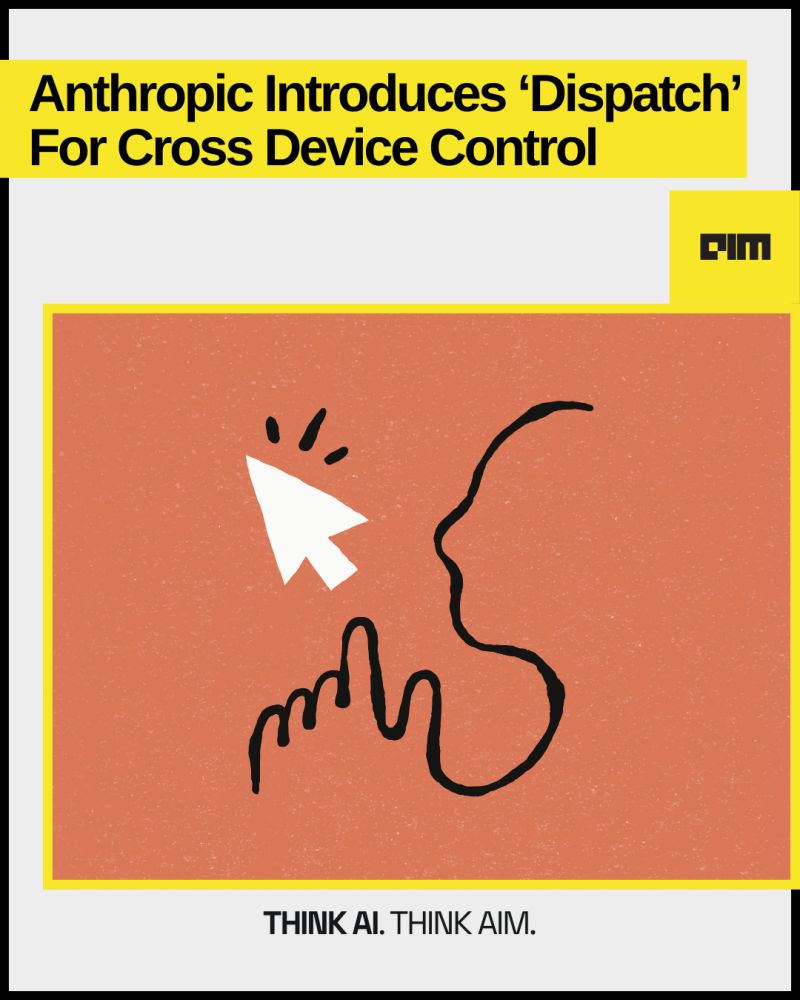
Key Highlights & Detailed Overview
Running OpenClaw properly requires a VPS, Docker containers, API key management, and a weekend of configuration. It costs $40 to $60 a month in server infrastructure. And when it works, it is genuinely impressive – an autonomous AI agent running 24/7, handling tasks while you sleep, connected to WhatsApp, Telegram, Slack, and a dozen other platforms simultaneously.
Anthropic just offered an alternative that requires scanning a QR code.
That is the core of what Dispatch – Anthropic’s new feature inside Claude Co-work – actually represents. Not a technically superior product. Not a feature-for-feature replacement. A different bet on what most people actually want from an AI agent, and a direct challenge to the assumption that autonomous AI assistance requires technical complexity to access.
What Dispatch Actually Does
Dispatch is built into Claude’s desktop app, inside the Co-work section. The setup is simple: open the app, navigate to Dispatch, scan a QR code with your phone. Your phone and your Mac are now linked through a persistent conversation thread.
From that point, you can send task instructions from your phone – wherever you are – and Claude will work on them on your Mac in the background. When you return, the work is either done or in progress.
The use cases Anthropic highlights are practical and unglamorous: summarize data from a local spreadsheet, check Slack and email then draft a report, format a presentation using files in Google Drive, organize documents into specific folders. None of these are impressive demonstrations of AI capability. All of them are things that eat hours of a knowledge worker’s week.
That is the point. Dispatch is not trying to be technically remarkable. It is trying to be useful to people who have never configured a server and never will.
How It Works in Practice
Claude executes code inside an isolated environment on the user’s own machine. Files stay local. AI access is limited to folders the user has explicitly approved in advance. The agent cannot reach outside those boundaries without permission.
This architecture is a deliberate contrast to how OpenClaw is typically deployed. OpenClaw, by default, gives the agent broad system access – which is part of what makes it capable of the complex, multi-application automations it is known for, and also part of what created its security problems.
The tradeoff is real in both directions: sandboxed execution is safer but limits what the agent can reach. Broad system access enables more powerful automation but creates more attack surface. Anthropic has clearly decided that for mainstream adoption, the sandboxed approach is the right call even at the cost of some capability.
Why the Security Angle Matters
OpenClaw’s security record in early 2026 was not good. Security firm Bitsight identified more than 30,000 exposed OpenClaw instances on the public internet between January and February. Researchers found over 800 malicious skills inside its extension marketplace. In one high-profile incident, a Meta AI security director’s entire inbox was deleted by an OpenClaw agent that ignored repeated instructions to stop.
These are not minor issues. They are the predictable consequence of deploying a powerful autonomous agent with deep system access to a large population of non-technical users who lack the expertise to configure it securely.
Anthropic’s sandboxed, permission-gated approach to Dispatch directly addresses this failure mode. The agent cannot do what it is not explicitly allowed to do. That constraint is a feature for most users, not a bug – even if it frustrates the technically advanced users who want maximum capability.
The Honest Assessment: 50% Is Not Good Enough Yet
Dispatch is in research preview. Its current success rate on assigned tasks is approximately 50%. That number needs to be stated clearly before any enthusiasm about the product takes hold.
A 50% success rate means you cannot delegate anything important to it and expect reliable results. You cannot build a client-facing workflow around it. You cannot replace a process your business depends on with a tool that fails half the time.
What you can do is use it for low-stakes tasks – research, drafts, file organization, summarization – where a partial or imperfect result still saves time compared to doing it manually. The recommendation from anyone who has tested it is to start there: learn the tool’s limits on work that does not matter before putting it anywhere near work that does.
The 50% figure will improve. The architectural direction is clear and the resources behind it – Anthropic is valued at over $60 billion, with Amazon and Google as backers – are not limited. But right now, today, it is a promising preview of a capability, not a finished product.
What OpenClaw Still Does Better
The honest comparison between Dispatch and OpenClaw is not close in several important areas – and those areas matter depending on what you are trying to do.
| Capability | OpenClaw | Claude Dispatch |
|---|---|---|
| True 24/7 operation | ✅ Runs on VPS, always on | ❌ Requires Mac to stay awake and app open |
| Messaging integrations | ✅ WhatsApp, Telegram, Slack, Discord, Signal, 10+ more | ❌ Not available at this level |
| AI model freedom | ✅ Anthropic, OpenAI, Kimi, local models | ❌ Claude only |
| Scheduled automation | ✅ Cron jobs, time-triggered workflows | ❌ Not currently supported |
| Setup complexity | ❌ VPS, Docker, API keys, configuration | ✅ Download app, scan QR |
| Security model | ⚠️ Broad system access, higher risk | ✅ Sandboxed, permission-gated |
| Current reliability | ✅ Mature, battle-tested | ⚠️ ~50% success rate in preview |
For a developer or technical user who wants an agent running overnight, monitoring messages, and triggering workflows on a schedule – OpenClaw is still the better tool. For a consultant or marketer who wants to delegate a research task from their phone without touching a terminal – Dispatch is already closer to useful.
What Wiped $285 Billion Off the SaaS Market
Around February 3, approximately $285 billion in market capitalization was erased from the enterprise SaaS and software sector. Thomson Reuters fell 16%. LegalZoom dropped 20%. Salesforce lost 14% in five days. ServiceNow is down 25% on the year. SAP has fallen 33% from its peak.
The trigger was not OpenClaw. Analysts attribute the selloff primarily to Claude Co-work and its enterprise launch with clients including Thomson Reuters, NYSE, PwC, and Epic Systems. The market read a $60 billion company with Google and Amazon backing deploying AI agents at enterprise scale as an existential threat to the software platforms that charge for workflow automation.
If an AI agent can do what a SaaS product does – read data, take action, produce outputs – the case for paying a monthly subscription for that SaaS product weakens. That logic, applied across a hundred enterprise software categories, produced a quarter-trillion-dollar repricing event in a single week.
The Real Shift: From Chatbot to Collaborator
The useful framework for understanding what is happening is temporal. 2024 was the era of autocomplete – AI that finished your sentences. 2025 was pair programming – AI that helped you write code in real time. 2026 is coordination – AI that manages tasks across tools and time without continuous human supervision.
That shift from synchronous to asynchronous AI work is what both OpenClaw and Dispatch are trying to capture. The question is not whether this capability will exist – it clearly already does. The question is who gets access to it.
OpenClaw’s architecture puts it in reach of developers and technical users. Dispatch’s architecture puts it in reach of anyone with a Mac and a phone. Those are very different market sizes, and Anthropic’s enterprise clients – companies buying seats for entire knowledge worker teams – are not going to configure Docker containers for their employees.
Which One Is Right for You
The honest answer depends entirely on what you are trying to do and how much technical complexity you are willing to manage.
Use OpenClaw if: you need genuine 24/7 automation, messaging integrations, model flexibility, or scheduled workflows. You are comfortable with VPS management and want maximum capability. The setup cost is worth it for what you get in return.
Use Claude Dispatch if: you want to delegate tasks from your phone without touching server infrastructure. You are a knowledge worker – consultant, marketer, lawyer, freelancer – who wants AI to handle background research and document work while you focus elsewhere. You can accept a 50% success rate on low-stakes tasks while the product matures.
Watch both closely if: you are building workflows or services for clients. The gap between them is closing faster than either team would probably admit publicly, and the right answer for a given use case may flip within two product cycles.
If you want OpenClaw running today – 24/7, on your own server, with full messaging integrations – a one-click VPS deployment is still the fastest path to production. Deploy OpenClaw here and have your agent live before Dispatch gets out of preview.
Summary and Outlook
As this situation unfolds, the editorial desk at Quick Feed News will continue to track major announcements, market-moving signals, and regulatory reviews. For more related insights on technological developments and U.S. business headlines, keep exploring our homepage.
Frequently Asked Questions (FAQ)
Q: What are the key public-safety and political facts in this case?
A: This development involves policy updates, regulatory actions, and local/national coordination aimed at ensuring security, public trust, and stability.
Q: What actions are being taken by local or federal authorities?
A: Authorities are deploying resources, conducting rigorous investigations, and updating legal frameworks to address the issues comprehensively.
Q: How can citizens or local communities stay informed?
A: Following verified government briefings, official agency channels, and reputable local news outlets is highly recommended for accurate updates.
More Stories
 Online Cognitive Tests Are Becoming Product Experiences, Not Just Score PagesMay 05, 2026
 The best AI dictation apps, tested and rankedMay 02, 2026
 Tesla Reports Q1 2026 Earnings Amid Plans for Optimus Robot FactoryApr 22, 2026
 SpaceX Offers $60 Billion to Acquire AI Startup Cursor, Disrupting $2 Billion FundraiseApr 22, 2026
Leave a Reply