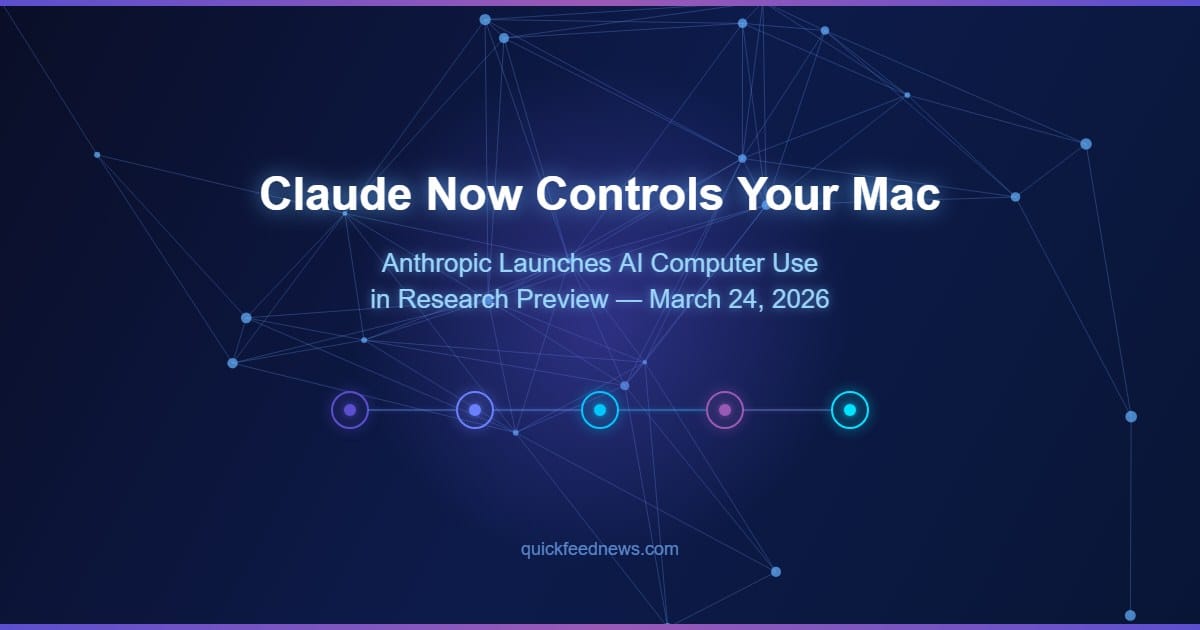
Anthropic is stepping firmly into the agentic AI race with a major new capability: Claude can now take control of your Mac computer to complete tasks on your behalf. Announced on March 24, 2026, the feature – currently available as a research preview – marks one of the most ambitious moves yet by any leading AI lab to transition its flagship model from a chatbot into a genuine autonomous agent capable of operating real software.
What Claude’s Computer Use Can Do
With the new computer use feature, Claude gains the ability to interact with a Mac just as a human user would. The AI can open applications, navigate web browsers, scroll through documents, fill in spreadsheets, and carry out multi-step workflows across software without the user needing to be present. Claude controls the machine by simulating mouse movements, keyboard input, and screen interaction – essentially acting as a remote operator inside the desktop environment.
Anthropic designed the system to prioritize precision. When a task involves services like Slack, Google Calendar, or other popular apps that have direct API connectors, Claude reaches for those first. Only when no connector is available does it fall back to direct screen-level computer control. This layered approach is meant to reduce errors and make the AI’s behavior more predictable.
The feature also integrates with Dispatch, Anthropic’s mobile companion app released just last week. With Dispatch, a user can message Claude a task from their iPhone – say, “compile the latest sales figures into a report” – and then return to find the work completed on their desktop.
Availability and Platform Support
The computer use capability is currently limited to Claude Pro and Claude Max subscribers on macOS. Anthropic confirmed that Windows support is in the pipeline, with availability expected “in the next few weeks.” Linux support has not yet been announced.
This rollout follows a broader trend of AI companies pushing into agentic territory. OpenAI, Google DeepMind, and other major players have all been racing to ship tools that let AI models execute real-world tasks autonomously – not just answer questions, but actually do things.
Safety and Permission Controls
Anthropic was candid about the early-stage nature of the feature. The company stated that computer use is “still early compared to Claude’s ability to code or interact with text,” and acknowledged that “Claude can make mistakes.” However, Anthropic emphasized that it built the capability with guardrails in place.
Critically, Claude will always request explicit permission from the user before accessing a new application. The AI does not autonomously expand its access without asking – a design choice intended to keep users in control and limit potential misuse or unintended consequences.
The company also stressed that users should remain vigilant and avoid leaving sensitive, unprotected data accessible while Claude is operating on their machine.
Claude Code Gets Auto Mode and New Channels
Alongside the consumer-facing computer use launch, Anthropic also announced major upgrades to Claude Code, its developer-focused agentic coding tool.
Claude Code is now receiving Auto Mode, a research preview feature that allows the AI to make judgment calls about which coding actions are safe to execute on its own – without requiring the developer to manually approve every step. Anthropic describes Auto Mode as a middle ground between Claude Code’s default configuration (which prompts for many permissions) and a fully permissive mode that skips checks altogether.
In addition, Anthropic announced Claude Code Channels, enabling developers to connect Claude Code to Discord and Telegram. This means teams can now message Claude Code directly through their existing communication platforms, instruct it to write code, run tasks, and receive updates – all without leaving their messaging app.
Claude Sonnet 4.6: A New Model Under the Hood
Powering many of these new features is Claude Sonnet 4.6, the latest version of Anthropic’s flagship model. The new release brings notable improvements in coding performance, long-context reasoning, and computer use accuracy. It also introduces a 1-million-token context window, currently available in beta – a significant upgrade that allows the model to process and reason over extremely large documents or codebases in a single session.
The Bigger Picture: The Race for AI Agents
Today’s announcements signal that Anthropic is accelerating its push to transform Claude from a conversational AI into a fully capable autonomous agent. The combination of computer use, Dispatch for mobile task delegation, Auto Mode for developers, and Claude Code Channels points toward a vision where Claude functions more like a digital employee than a chatbot.
Analysts and developers are watching closely. As AI agents gain the ability to operate real software, manage files, and take action on behalf of users, the stakes – and the responsibilities – grow considerably. Anthropic’s emphasis on permission-based controls and transparent safety messaging suggests the company is keenly aware of those stakes.
For now, Claude’s computer use is a research preview. But if Anthropic’s track record holds, a broader rollout may not be far behind.
Summary and Outlook
As this situation unfolds, the editorial desk at Quick Feed News will continue to track major announcements, market-moving signals, and regulatory reviews. For more related insights on technological developments and U.S. business headlines, keep exploring our homepage.
Frequently Asked Questions (FAQ)
Q: What is the main technological breakthrough discussed in this article?
A: This development represents a significant step in autonomous AI scaling, enterprise integrations, and high-performance computing capabilities designed to streamline business workflows.
Q: How does this impact regular users and developers?
A: It lowers the barrier to deploying advanced AI systems locally, though it raises questions regarding hardware requirements, API costs, and data governance policies.
Q: What are the security or privacy implications?
A: As AI models integrate deeper into workflows, securing proprietary data and protecting against supply-chain risks remains a top priority for IT executives.
More Stories
 Online Cognitive Tests Are Becoming Product Experiences, Not Just Score PagesMay 05, 2026
 The best AI dictation apps, tested and rankedMay 02, 2026
 Tesla Reports Q1 2026 Earnings Amid Plans for Optimus Robot FactoryApr 22, 2026
 SpaceX Offers $60 Billion to Acquire AI Startup Cursor, Disrupting $2 Billion FundraiseApr 22, 2026